
©2025
WaterTech Bootcamp
WaterTech Bootcamp
WaterTech Bootcamp
WaterTech Bootcamp
Whether it’s through stunning designs seamless user experiences, I’m dedicated to delivering work that resonates.
ABOUT
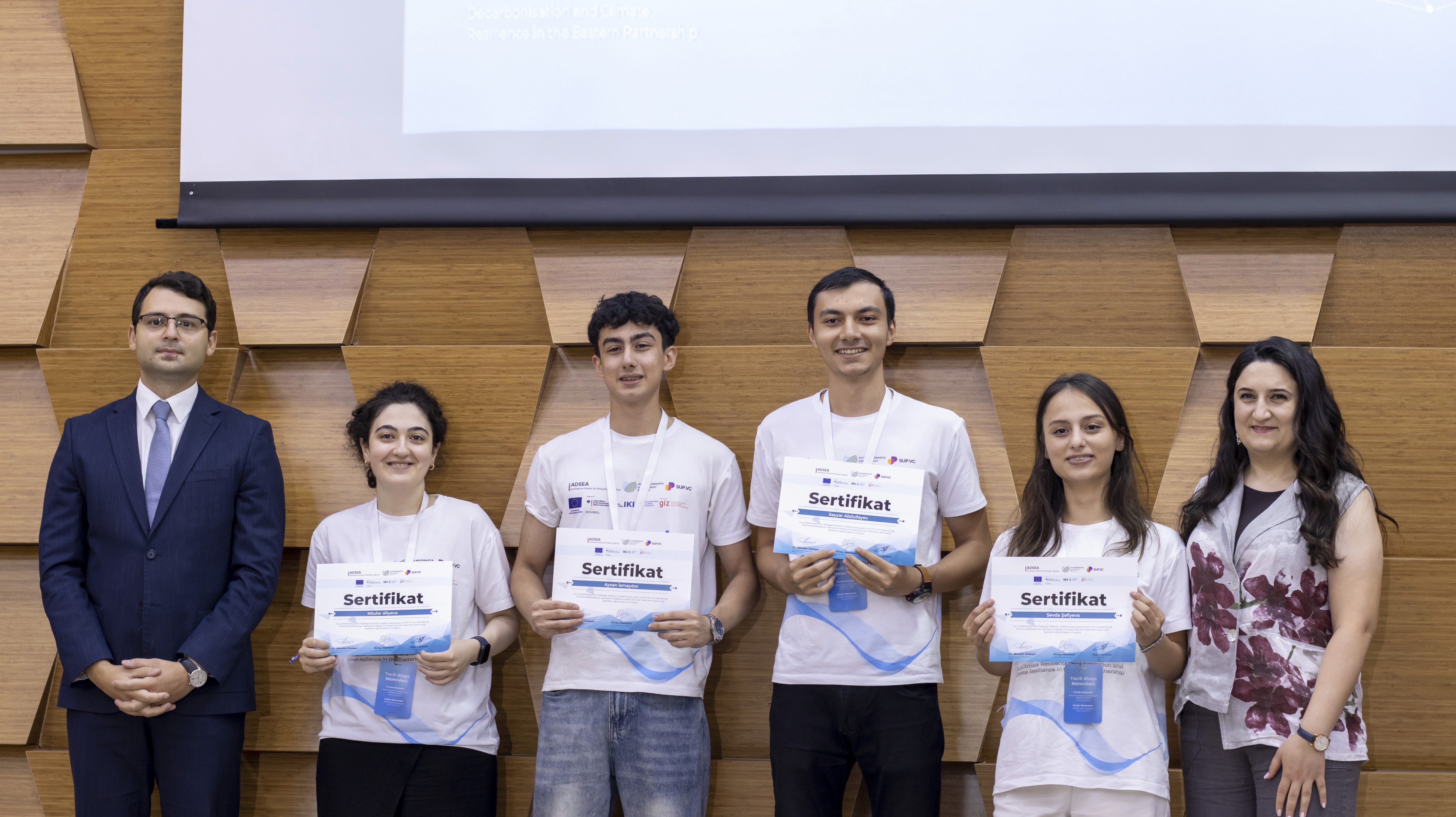
➢ WaterTech Bootcamp is a four-day intensive training and hackathon program built to bring artificial intelligence and innovative technology to one of Azerbaijan's most strategically important sectors water resource management. The program was held from 5 to 8 September 2025 at the Training and Innovations Center of the State Water Resources Agency of Azerbaijan (ADSEA), and was organised by the Water and Reclamation Scientific Research Institute, an entity under ADSEA, together with SUP.VC as the operating partner. The program was delivered with the support of the EU4ClimateResilience project, which is funded by the European Union and Germany's Federal Ministry for the Environment, Climate Action, Nature Conservation and Nuclear Safety (BMUKN), and implemented by GIZ and OECD. From a pool of 305 applicants, 60 young participants were selected to train on AI and digital tools applied to real challenges in water resource management, with the strongest ideas evaluated by a jury and put on a path toward implementation.
The brief
➢ Water is one of the few resources where the gap between policy ambition and operational capability translates directly into climate risk. For Azerbaijan, where water management sits at the intersection of agriculture, energy, urban growth, and regional security, the strategic challenge is not whether to modernise the sector it is how fast the institutional workforce can absorb the technologies that modernisation requires. ADSEA's challenge was to engage a new generation of technical talent with the sector's real problems, demonstrate that AI and innovative tooling could be applied to live water-management questions rather than treated as abstract concepts, and do so inside a credible operational framework that international partners the European Union, BMUKN, GIZ, OECD could stand behind. A four-day bootcamp combining training and a hackathon, run on the agency's own premises, was the format chosen to do all three at once.
Why ADSEA partnered with SUP.VC
➢ A national water agency is built to manage infrastructure, not to run an applicant pipeline of 300+ candidates or to operate a four-day hybrid training-and-hackathon program. The expertise, the data, the strategic mandate, and the institutional credibility live inside ADSEA and its Water and Reclamation Scientific Research Institute. The program operating system outreach, applicant evaluation, curriculum, mentor coordination, hackathon design, jury management, and the institutional relationships with international donors sits outside. ADSEA partnered with SUP.VC for the same reason public sector institutions internationally rely on specialist innovation operators when running this kind of cross-sector program: the agency brings the problems, the data, and the leadership exposure; the operator runs the program. SUP.VC contributed end-to-end program design and operations, the mentor network spanning AI, data, and applied technology, the operational capacity to filter 305 applicants down to a cohort of 60 in a short window, and the experience of running multi-stakeholder programs that combine public sector leadership with international donor support.
How the program worked
➢ WaterTech Bootcamp ran as a four-day intensive at ADSEA's Training and Innovations Center. From an initial pool of 305 applicants, 60 young participants were selected to enter the program a competitive funnel that ensured a high baseline of technical and motivational quality. Across the four days, participants combined theoretical training with hands-on hackathon work, organised into teams that developed AI- and technology-based concepts addressing real water resource management challenges set by the agency. The strongest ideas were evaluated by a jury at the close of the program, with winning teams recognised through prizes and follow-on opportunities to take their concepts further. The opening ceremony was led by Ilham Bayramov, Deputy Chair of ADSEA, and Mir Movsum Dadashev, Chair of the Management Board of the Water and Reclamation Scientific Research Institute, who framed the program as a starting point for ideas that could become the basis of future large-scale projects in the sector.
What ADSEA and the broader ecosystem gained
➢ The first outcome is technical. Across four days, 60 young engineers, data specialists, and designers produced a portfolio of AI-driven concepts addressing live operational challenges in water management. For an agency that procures technology through long, capital-heavy cycles, this is a fundamentally faster way to surface workable ideas the venture-clienting principle applied to a national infrastructure agency, with the cost of experimentation absorbed by the program rather than by procurement. The second outcome is talent. The program created a direct, high-signal relationship between ADSEA and over 300 of the most technically motivated young professionals in the country with an interest in water, sustainability, and applied AI. The 60-person cohort that went through the bootcamp now sits inside a recurring relationship with the agency, the Research Institute, and the wider water management sector a talent pipeline that no traditional recruitment channel could have built in four days.
➢ The third outcome is positioning inside the climate resilience agenda. By running WaterTech Bootcamp under the EU4ClimateResilience umbrella, a program backed by the EU, BMUKN, GIZ, and OECD - ADSEA positioned itself as a credible operational partner inside the international climate finance and technical cooperation ecosystem. This is a strategic asset that compounds: each successful program inside an international donor framework makes the next one easier to design, fund, and scale. The fourth outcome is institutional modernisation. For the State Water Resources Agency and its Research Institute, running a hackathon-format program on their own premises sends a signal as strong externally as internally the agency is willing to open its data, its problems, and its physical infrastructure to a new generation of technical talent. That cultural shift is the foundation on which every future innovation program in the sector will be built.
➢ WaterTech Bootcamp is a four-day intensive training and hackathon program built to bring artificial intelligence and innovative technology to one of Azerbaijan's most strategically important sectors water resource management. The program was held from 5 to 8 September 2025 at the Training and Innovations Center of the State Water Resources Agency of Azerbaijan (ADSEA), and was organised by the Water and Reclamation Scientific Research Institute, an entity under ADSEA, together with SUP.VC as the operating partner. The program was delivered with the support of the EU4ClimateResilience project, which is funded by the European Union and Germany's Federal Ministry for the Environment, Climate Action, Nature Conservation and Nuclear Safety (BMUKN), and implemented by GIZ and OECD. From a pool of 305 applicants, 60 young participants were selected to train on AI and digital tools applied to real challenges in water resource management, with the strongest ideas evaluated by a jury and put on a path toward implementation.
The brief
➢ Water is one of the few resources where the gap between policy ambition and operational capability translates directly into climate risk. For Azerbaijan, where water management sits at the intersection of agriculture, energy, urban growth, and regional security, the strategic challenge is not whether to modernise the sector it is how fast the institutional workforce can absorb the technologies that modernisation requires. ADSEA's challenge was to engage a new generation of technical talent with the sector's real problems, demonstrate that AI and innovative tooling could be applied to live water-management questions rather than treated as abstract concepts, and do so inside a credible operational framework that international partners the European Union, BMUKN, GIZ, OECD could stand behind. A four-day bootcamp combining training and a hackathon, run on the agency's own premises, was the format chosen to do all three at once.
Why ADSEA partnered with SUP.VC
➢ A national water agency is built to manage infrastructure, not to run an applicant pipeline of 300+ candidates or to operate a four-day hybrid training-and-hackathon program. The expertise, the data, the strategic mandate, and the institutional credibility live inside ADSEA and its Water and Reclamation Scientific Research Institute. The program operating system outreach, applicant evaluation, curriculum, mentor coordination, hackathon design, jury management, and the institutional relationships with international donors sits outside. ADSEA partnered with SUP.VC for the same reason public sector institutions internationally rely on specialist innovation operators when running this kind of cross-sector program: the agency brings the problems, the data, and the leadership exposure; the operator runs the program. SUP.VC contributed end-to-end program design and operations, the mentor network spanning AI, data, and applied technology, the operational capacity to filter 305 applicants down to a cohort of 60 in a short window, and the experience of running multi-stakeholder programs that combine public sector leadership with international donor support.
How the program worked
➢ WaterTech Bootcamp ran as a four-day intensive at ADSEA's Training and Innovations Center. From an initial pool of 305 applicants, 60 young participants were selected to enter the program a competitive funnel that ensured a high baseline of technical and motivational quality. Across the four days, participants combined theoretical training with hands-on hackathon work, organised into teams that developed AI- and technology-based concepts addressing real water resource management challenges set by the agency. The strongest ideas were evaluated by a jury at the close of the program, with winning teams recognised through prizes and follow-on opportunities to take their concepts further. The opening ceremony was led by Ilham Bayramov, Deputy Chair of ADSEA, and Mir Movsum Dadashev, Chair of the Management Board of the Water and Reclamation Scientific Research Institute, who framed the program as a starting point for ideas that could become the basis of future large-scale projects in the sector.
What ADSEA and the broader ecosystem gained
➢ The first outcome is technical. Across four days, 60 young engineers, data specialists, and designers produced a portfolio of AI-driven concepts addressing live operational challenges in water management. For an agency that procures technology through long, capital-heavy cycles, this is a fundamentally faster way to surface workable ideas the venture-clienting principle applied to a national infrastructure agency, with the cost of experimentation absorbed by the program rather than by procurement. The second outcome is talent. The program created a direct, high-signal relationship between ADSEA and over 300 of the most technically motivated young professionals in the country with an interest in water, sustainability, and applied AI. The 60-person cohort that went through the bootcamp now sits inside a recurring relationship with the agency, the Research Institute, and the wider water management sector a talent pipeline that no traditional recruitment channel could have built in four days.
➢ The third outcome is positioning inside the climate resilience agenda. By running WaterTech Bootcamp under the EU4ClimateResilience umbrella, a program backed by the EU, BMUKN, GIZ, and OECD - ADSEA positioned itself as a credible operational partner inside the international climate finance and technical cooperation ecosystem. This is a strategic asset that compounds: each successful program inside an international donor framework makes the next one easier to design, fund, and scale. The fourth outcome is institutional modernisation. For the State Water Resources Agency and its Research Institute, running a hackathon-format program on their own premises sends a signal as strong externally as internally the agency is willing to open its data, its problems, and its physical infrastructure to a new generation of technical talent. That cultural shift is the foundation on which every future innovation program in the sector will be built.


Let's work together
Let's build what's next.
Let's build what's next.
Let's build what's next.
Whether you're a company looking to innovate or a public institution ready to modernize, we'd like to hear what you're working toward.
Tell us your goal — we'll come back with a concrete way to get there.